The room you keep closing the door on
I could write the version of this that sounds like every other interiors blog. Something about creating calm. Designing a space that breathes. You've read it. I've read it. It says nothing.
So here's what I actually want to talk about.
Most people who get in touch with me already know what they want their home to feel like. They've saved the images. Screenshot the tiles. There's a Pinterest board called "one day" with four hundred pins and a small knot in the stomach every time it opens.
The problem was never taste. It's bandwidth.

You're working. Maybe parenting, maybe not. Running a home that functions.. just, while quietly aware that the kitchen doesn't, the bedroom still doesn't feel like yours, the spare room has somehow become storage, and the living room is a patchwork of things you inherited, things you panic bought in 2021, and things you keep meaning to replace but can't face adding to the list.
So you close the door.. literally, or just in your head. You stop seeing the room because seeing it and not being able to fix it is worse.
I know that feeling. Not as a designer, but as a person who's lived it.
I spend my days making other people's homes work down to the last detail. Getting the light right, the proportions right, the flow right. Then I go home and, roughly every other week, say to my husband: "right, this weekend we sort the basement". I first said that two years ago. The basement is still a dumping ground for everything we don't know what to do with and can't quite face dealing with. So when I say I understand, I mean it. The room you can't look at - I've got mine too.

The state of your home and the state of your head are in constant conversation. One feeds the other. A cluttered surface isn't only mess, it's a standing reminder of everything unfinished. A half sorted corner isn't neutral — it's one more open tab in a brain already running forty seven.
There's research behind this, not just a feeling. Researchers studying dual-income households found that the women who described their homes as cluttered or unfinished had cortisol (the stress hormone) that stayed elevated through the day instead of tapering off the way it's meant to. Not because they cared too much about interiors. Because they were already carrying the logistics, the decisions, the invisible admin of a whole household, and the house kept adding to the pile.
Your home is either giving you something back at the end of the day, or quietly taking more. There isn't much of a middle.
Then there's the choice problem, which has only got worse.
Thirty years ago you picked a kitchen from a brochure and got on with your life. Now there are nine hundred handles on one website. Four thousand tiles. A dozen paint brands, each with their own version of off-white, and someone online ready to tell you the one you chose is already over.
It isn't inspiration. It's noise. And when you're already at capacity, noise doesn't help you decide — it freezes you.
I see it constantly. Capable, switched-on people who've been "meaning to sort the house" since the day they moved in. Not because they're lazy — because every time they start, the options multiply, the decisions stack, and it becomes one more thing they can't get to the end of. So the board grows. The door stays shut. The room stays exactly as it is.
I didn't start this studio to add to that.
The whole thing is built on one idea: your home should take weight off you, not pile more on. That's the finished room, obviously — the one that drops your shoulders the second you walk in. But it's just as much the process of getting there.
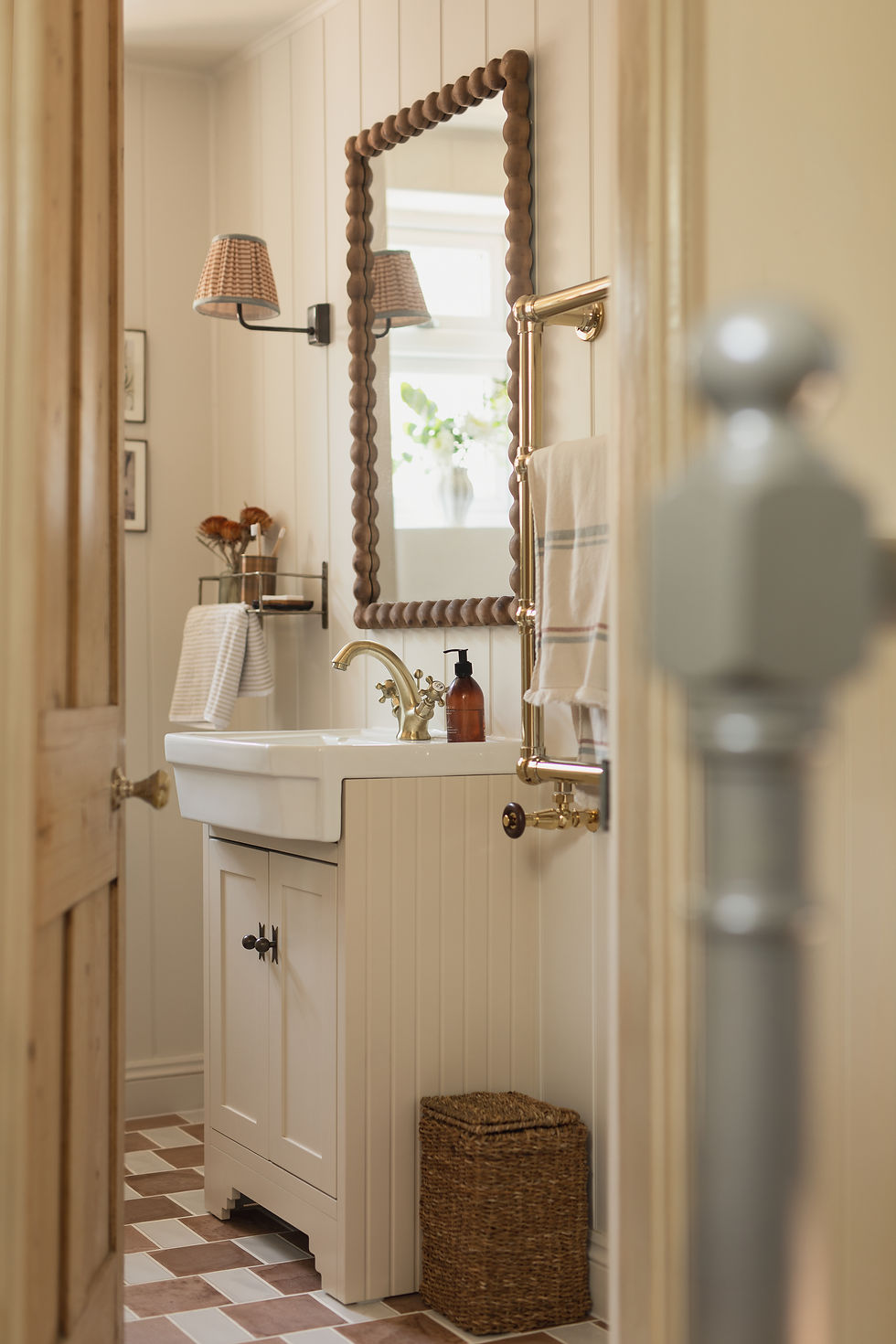
If the project itself becomes another source of overwhelm, I've lost before the paint's dry.
So I take the decisions off your plate. Not by overriding what you want — by listening closely enough to hear the bits you can't quite say. Because most people come to me with a feeling more than a plan. You know something isn't right. You know the rough shape of what you want. But the picture is half-formed — you can't always put words to what it should actually look like, even though some part of you already knows. My job is to hear that. To take the fragment you can give me and find the whole room inside it.
You don't need nine hundred handles. You need the right three, from someone who already knows which will work in your space, your light, your life.
That isn't a nice-to-have. For a lot of people right now, it's the difference between the project happening and it staying on the "one day" list for another year.
Here's the thing I keep coming back to.
You know what you like. You've always known. The gap was never taste — it's the space between what you're drawn to and understanding why a room won't come together. Why it feels off even when everything in it is, technically, fine.
Usually it comes down to a handful of things. The proportions are slightly out. The lighting is doing one job when the room needs three. There's a single piece quietly fighting everything around it, or the whole thing is missing one note: texture, contrast, something low and grounding, that would have pulled it together. You feel all of that long before you could ever put a name to it. Naming it is half my job. Fixing it is the other half.
That's the part I love. That's the part I'm actually for.
So if you're reading this with a particular room in mind (the one behind the door you keep closed) that's the one I'd want to hear about.
Jess x

Comments